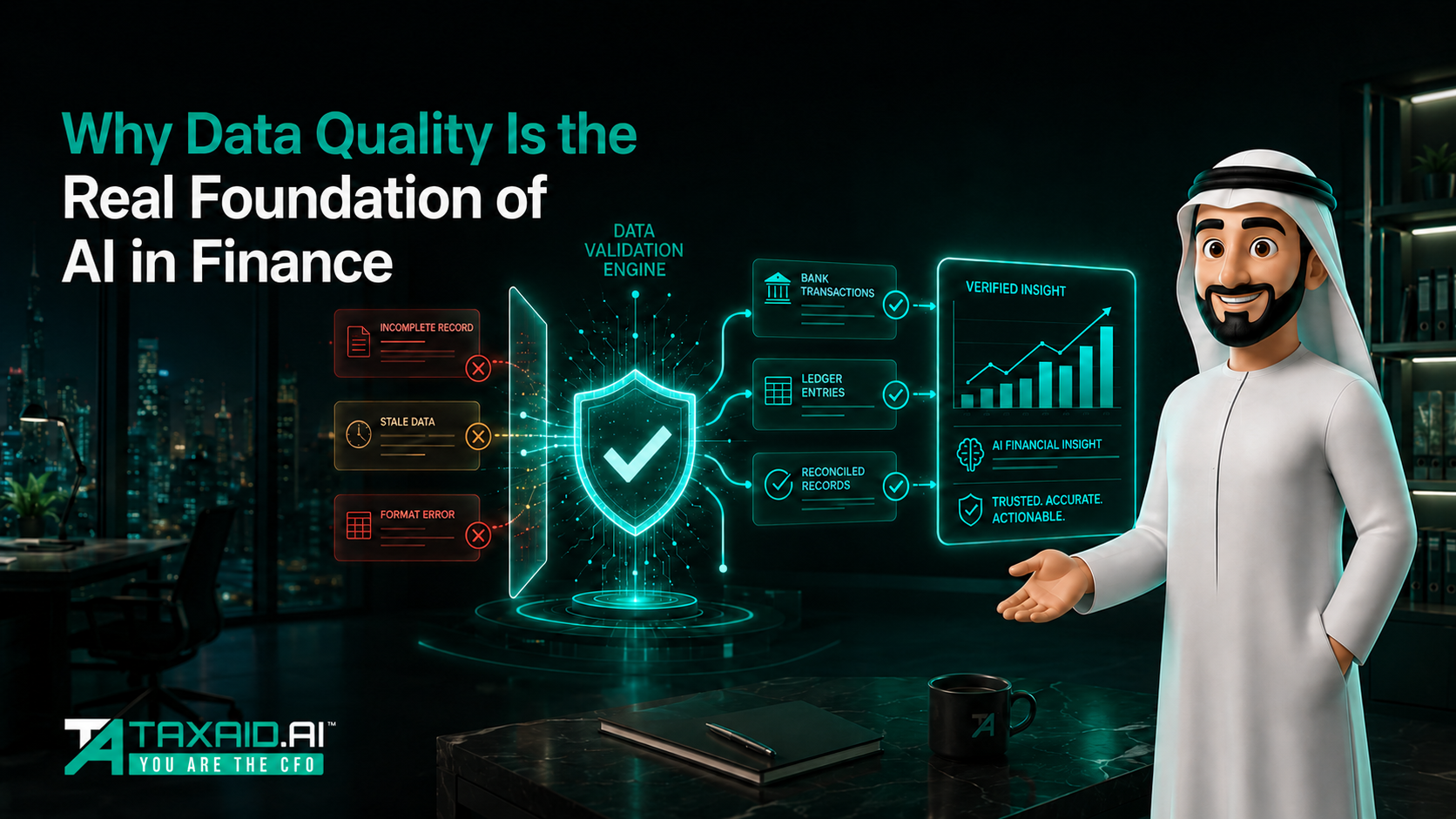
A finance dashboard can look flawless and still be wrong.
The charts are clean. The numbers appear precise. The interface looks sophisticated. But underneath it all, the bank feed may not have synced for three weeks, the ledger may contain unmapped transactions, or the latest reconciliation may still be incomplete.Unless the system is specifically designed to identify these gaps, it may continue reporting as though everything is correct.
This is one of the quietest and potentially most expensive failure points in AI-powered finance.
Because when inaccurate financial data enters an intelligent system, the output does not always look uncertain. It can arrive fluently, confidently and completely wrong.
AI in finance is only as reliable as the data underneath it
Artificial intelligence can analyse financial information faster than any human team. It can identify patterns, detect unusual movements, forecast potential outcomes and surface insights that might otherwise remain hidden.
But AI cannot manufacture financial truth from incomplete records.
Stale bank reconciliations, missing invoices, incorrectly classified expenses, incomplete VAT records and ledgers that have not been properly closed all weaken the quality of the information produced.
The risk is not simply that the system might fail to provide an answer.
The greater risk is that it provides a convincing answer built on an unreliable foundation.
In finance, that can lead to:
- Cash-flow decisions based on outdated balances
- Profitability analysis distorted by incorrect classifications
- Tax or VAT positions calculated from incomplete records
- Forecasts built on assumptions that no longer reflect reality
- Management decisions made with false confidence
That is why data quality in AI-powered finance is not merely a technical concern. It is a financial, operational and compliance concern.
A principle worth borrowing from - Traction
In Traction, Gino Wickman introduces the Scorecard: a focused set of measurable numbers reviewed consistently so that emerging problems become visible before they turn into crises.
The underlying principle is simple: a business should not be managed entirely through instinct, assumptions or occasional reports. Leaders need dependable numbers, reviewed on a defined cadence.
Wickman describes this as the Data component of the business which is separate from vision, people and process. That distinction matters.
A clear vision cannot compensate for inaccurate numbers. Strong people cannot make reliable decisions using incomplete information. And even the best process will eventually fail if nobody can trust what the data is saying.
Most business leaders agree with this principle.
The harder question is whether the financial technology they use actually enforces it.
AI does not automatically correct bad financial data but it can amplify it
An AI-powered finance system is only as reliable as the data it receives and the validation controls surrounding it.
When the source data is incomplete, the system may detect an inconsistency but only if it has been designed to perform that validation. Otherwise, it can analyse the available information and produce an answer that appears entirely reasonable.
This creates a dangerous combination: High confidence. Low accuracy.
In financial management, confidence without accuracy is one of the costliest forms of technology failure because it rarely presents itself as a visible system error.
It presents itself as an answer.
The business may only discover the problem after making a decision, submitting a filing, committing cash or communicating incorrect information to stakeholders.
Why traditional finance software can leave a critical gap
The traditional SaaS model is well established:
The client purchases a licence. The software is configured. The users are onboarded. The platform then runs independently, with support provided when a technical issue is reported.
For task management, communication or scheduling tools, that model can work well.
Financial intelligence is different.
Financial data changes every day. Bank transactions arrive. Invoices are raised. Payments are delayed. Ledgers are updated. Forecasts change. Reconciliations fall behind.
A system that was accurate when it was implemented is not automatically accurate three months later.
Yet most platforms concentrate on whether the software is functioning and not whether the financial information flowing through it continues to reflect the reality of the business.
That is the gap TaxAid AI is designed to address.
Why structured financial reviews are part of the TaxAid AI model
Every TaxAid AI client goes through a structured monthly financial and data-quality review.
This is not a routine customer-service call.
The purpose is to examine whether the information supporting Akeel remains current, complete and reliable. The objective is not merely to confirm that the interface looks right. It is to verify that the financial foundation underneath the interface remains dependable.
Technology provides speed, scale and continuous analysis. Human financial oversight provides context, professional judgement and accountability.
For sensitive financial decisions, businesses need both.
Across the finance technology industry, the race is toward more automation, more integrations and more AI-generated insights. But there is a more fundamental question that must come first: Is the underlying financial data reliable enough to support the intelligence being built on top of it.
More automation does not solve an unreliable data foundation. It simply allows unreliable information to move faster.
At TaxAid AI, data validation is therefore not treated as a background technical function. It is part of the operating model.
Financial information can come from accounting-system connectors, user inputs and supporting operational records. Before that information powers AI-generated insights, it must be checked, reconciled and validated.This helps ensure that Akeel is not simply producing more financial information but producing intelligence the business can act upon with greater confidence.
The future of AI in finance depends on trust
The businesses that benefit most from AI will not necessarily be those with the most dashboards, the largest number of integrations or the greatest volume of automated reports.
They will be the businesses that can trust the data beneath them.
A metric reviewed consistently can reveal more than a strategy discussed occasionally. In AI-powered finance, that is not a nice-to-have principle. It is the difference between a system that supports sound business decisions and one that quietly undermines them.
That distinction is the foundation TaxAid AI is being built on.